

 Engineering
 Production automation
 Testing
 Virtual accident experience
 Innovation
 Aerospace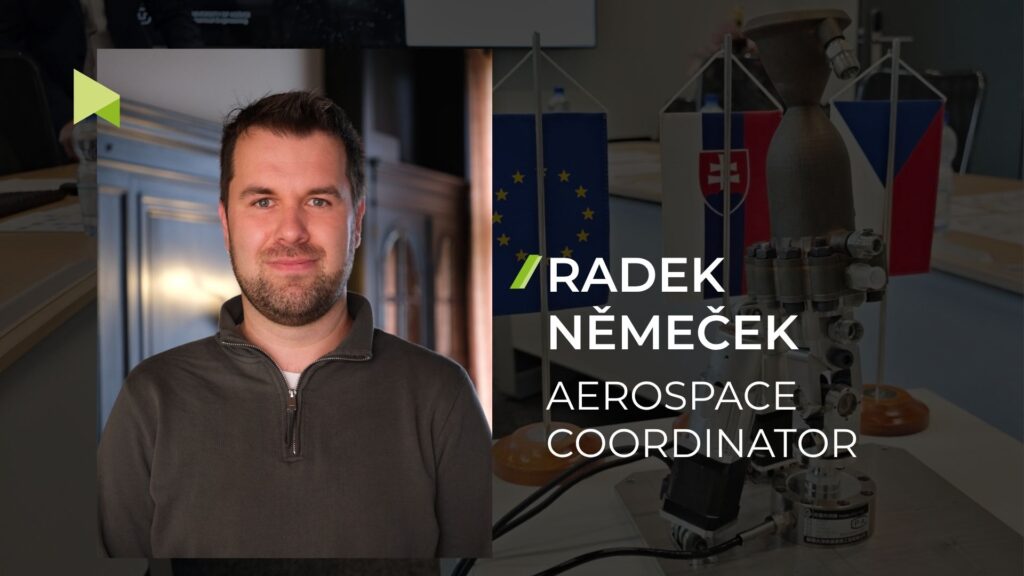
Radek Němeček has been part of AUREL for more than ten years. During that time, he has held a wide range of technical roles, from testing and analysis to his current position, where he plays a key role in bringing together AUREL’s automotive expertise with new opportunities in the aerospace industry.
Mr Němeček, when you look back at your early career in automotive safety testing, did you ever imagine that one day you would be sitting around the table with a space agency discussing rocket propulsion systems?
Honestly, no. Even ten years ago, when I joined AUREL as a Test Engineer specialising in passive safety, I didn’t really know what to expect. In many ways, it’s been exactly the same with the new role I’ve taken on.
The JARMIL project brought together the teams at AUREL and LENAM in an entirely new technical field. Having experts within one group who can design systems digitally, carry out simulations and then validate everything through real-world testing is quite unusual. Does this integrated approach make a difference to your partners? Does it influence their decision-making?
Absolutely. The fact that our group can provide all of these capabilities under one roof is extremely valuable to our partners in the aerospace industry. There are many organisations that excel in individual disciplines, but very few that can offer this entire range of expertise within a single group.
The AUREL Group has been working with some of the world’s leading automotive manufacturers for many years. The industry is known for its relentless focus on precision and demanding delivery schedules. Has this rigorous automotive background helped you in aerospace projects, where the expectations for reliability are equally high?
Absolutely. Although the two industries have their differences, they also share many similarities. The experience we have gained working with leading automotive manufacturers is highly transferable and provides a strong foundation for tackling the challenges of the aerospace sector.
The Břehyně proving ground is a secure, restricted-access facility with stringent security certification. How important is it to have your own testing facility when working with international partners?
Our proving ground is dedicated primarily to automotive testing, so at present it does not play a direct role in our aerospace projects. However, the fact that we are capable of operating a large-scale testing facility under strict confidentiality demonstrates our ability to meet demanding requirements and manage projects involving the highest levels of security and operational discipline.
The New Space sector is often described as being much faster and more dynamic than the traditional space industry. Given your background in automotive, do you feel naturally at home in this fast-paced environment?
The automotive industry has traditionally been quite structured, and before the COVID-19 pandemic, development processes were generally less agile. Projects followed well-established timelines, and there was less pressure to move at speed. However, the pandemic changed that significantly, and today the pace of development in the automotive has accelerated considerably. In many ways, I think the New Space sector operates with a very similar mindset.
How far would you like to take the AUREL Group’s activities in the space sector? Do you have a particular type of project or customer that you aspire to work with one day?
At the moment, we’re only at the very beginning of this journey, so I could mention some of the biggest names in the aerospace industry – but I won’t. Our immediate goal is to successfully deliver the projects we already have under way, particularly the JARMIL project, as well as several others that I’m not yet in a position to discuss.
Why should a European satellite or rocket manufacturer choose to work with AUREL rather than one of the established major players in the industry?
Perhaps precisely because we’re not one of the large, established players. We provide comprehensive engineering services.
What does it mean to you personally to be involved in developing technologies that will actually make it into space?
Above all, it means I’ve started working with people who really know what they’re doing – and I find that incredibly inspiring.