

 Engineering
 Production automation
 Testing
 Virtual accident experience
 Innovation
 Aerospace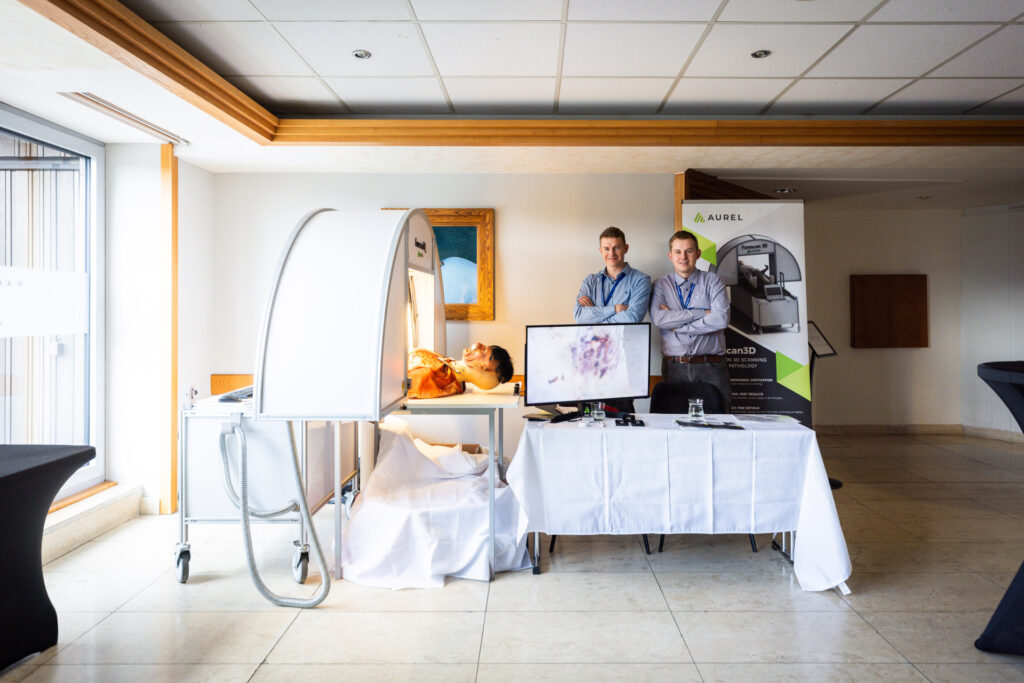
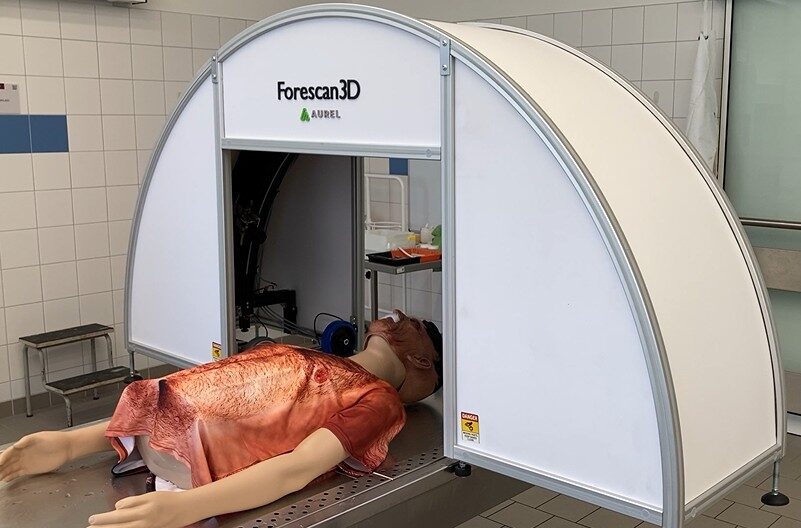
AUREL is a trusted partner to leading Czech and international automotive manufacturers. Today, however, its expertise extends far beyond the automotive industry. One example is ForeScan3D – AUREL’s proprietary scanning technology for capturing highly detailed 3D records of the human body and a wide range of other objects. A single scan can replace hundreds of photographs, creating an accurate, measurable 3D model that can be revisited at any time. We spoke with Štěpán Cvejn, Business Manager at AUREL, about the opportunities this technology brings to everyday professional practice.
Mr Cvejn, to begin with, could you introduce ForeScan3D to our readers?
We built on AUREL’s many years of experience in advanced optical 3D measurement for the automotive industry and developed our own proprietary technology. ForeScan3D is an automated system that creates a highly accurate three-dimensional model of the human body’s structure. At the same time, it captures even the finest surface details, including texture, colour variations, and other subtle features. The result is a digital replica of the actual condition that can be analysed in detail.
Although ForeScan3D is primarily intended for forensic science, forensic medicine, and pathology, it can be used wherever there is a need to accurately document and preserve the condition of an object for future analysis. Experts can return to the 3D model at any time, carry out additional measurements, or prepare documentation even long after the original scan was taken.
How did the idea of bringing 3D scanning technology from an engineering environment into forensic medicine first come about?
At AUREL, we’ve been working with 3D measurement, scanning, and technical data processing for more than twenty years. Over that time, we’ve gained extensive experience in developing measurement technologies for demanding industrial applications. We started asking ourselves where our expertise could make a difference beyond industry, and that’s how the idea of applying it to forensic medicine and pathology emerged – fields where accurate, repeatable, and permanently preserved documentation is of exceptional value.
Perhaps the fact that our office in Liberec is right next to the pathology department also played a part. In any case, it was important to us from the outset that ForeScan3D should not become just another laboratory prototype. The entire system was developed in close collaboration with the pathology department in Liberec, where it was tested in day-to-day clinical practice for more than a year. This meant we weren’t focusing solely on the scanning technology itself, but above all on the everyday needs of medical professionals and the way they work.
For us, this is really a natural progression. We know how to develop highly accurate measurement technologies, and it makes perfect sense to look for new fields where they can deliver real value. ForeScan3D is a great example of how expertise gained in the automotive industry can find highly practical applications in entirely different sectors.
What do you see as the greatest benefits of ForeScan3D for day-to-day practice?
For forensic pathologists, one of the greatest advantages is the ability to return to a case at any time. The body changes, the post-mortem examination is completed, and the original condition can never be recreated exactly. A digital 3D record, however, remains available. It allows the pathologist to revisit the model, examine specific areas again, take additional measurements, or prepare documentation whenever needed.
Another major benefit is standardisation. Conventional photographic documentation depends heavily on the individual taking the photographs – the viewing angle, lighting, scale, and how systematically the images are captured. ForeScan3D helps standardise the entire process and significantly reduces the potential for human error. Its high level of accuracy ensures that even the finest details are captured, including those that may prove crucial to an investigation. This is something that professionals in the field genuinely value.
Another significant advantage is how intuitive and easy the system is to operate. I often say, only half-jokingly, that anyone who can use a coffee machine can learn the basics of operating this scanner. Naturally, that comes after proper training and by following the correct procedures, but the operation itself is genuinely straightforward. From the very beginning, we wanted to create a system that wouldn’t add complexity to the workplace. On the contrary, it’s designed to take over part of the routine workload.
Last but not least, it saves a considerable amount of time.
Who are the primary users of ForeScan3D? Is it intended exclusively for forensic pathologists, or does it have applications in other fields as well?
At present, our primary focus is on forensic medicine, pathology, and forensic departments. That’s the environment ForeScan3D was developed for, and where we believe it delivers the greatest value.
Looking ahead, however, we don’t want to limit its application to a single field. On the contrary, we see considerable potential across a range of other disciplines. Wherever there is a need to accurately document the surface of the body, a specific body part, or a particular finding, a system like this can provide real benefits. It may be used for personal identification, education, research, or specialist consultations between institutions. The underlying principle is always the same: to create a high-quality digital record that can be revisited whenever needed.
Is ForeScan3D intended solely for the Czech market, or are you also looking abroad?
We certainly don’t want to limit ourselves to the Czech market. We’ve already presented ForeScan3D at international conferences and established contacts with experts and institutions specialising in forensic and security technologies across Europe. It’s becoming increasingly clear that the demand for accurate digital solutions is growing, and our technology is well positioned to meet that demand. At the same time, it’s further confirmation that the expertise AUREL has built up in the automotive industry can be successfully applied to other fields as well. That’s exactly the direction we intend to continue pursuing.
Does that mean you’re already seeing concrete opportunities for international collaboration?
Yes, we’re already seeing strong interest from organisations outside the Czech Republic. At the moment, Slovakia is looking particularly promising. We presented ForeScan3D at the Czech–Slovak Congress of Forensic Pathologists in Špindlerův Mlýn, and it was there that we established several promising contacts. At the same time, we’re looking further afield – to the rest of Europe and beyond.
At the Czech–Slovak Congress of Forensic Medicine, there was considerable discussion about using the outputs as evidence. How does your scanner help create more reliable documentation
ForeScan3D creates a calibrated 3D record of the body’s surface, so the output is not merely a set of photographs taken from different angles, but a complete, measurable three-dimensional model. Depending on the operating mode, the system achieves an accuracy of up to ±1 mm at a measuring distance of 1 metre. This is particularly important when documenting surface features, injuries, scars, or tattoos, as they can be revisited in the model and verified again at a later stage.
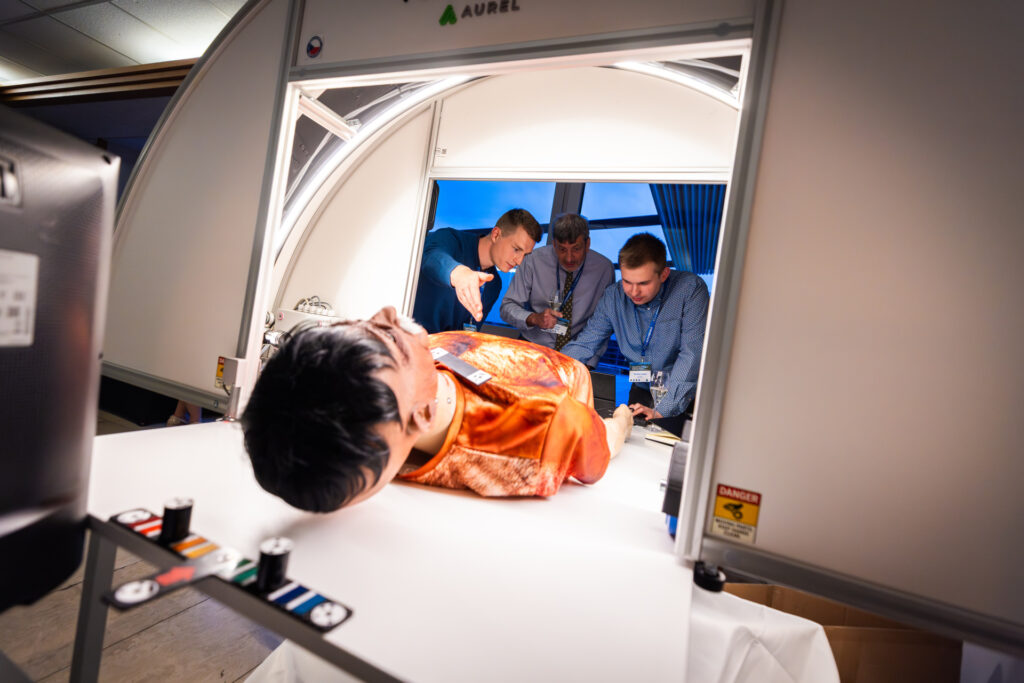
Zdroj: Czech-Slovak Congress of Forensic Medicine
Medical professionals are often interested in processing speed. How long does it take to create a complete 3D model?
Our experience shows that, once properly integrated into the workflow, ForeScan3D takes over a significant part of the routine workload and delivers substantial time savings for medical professionals. The scanning process itself takes approximately 10 to 15 minutes, depending on the selected operating mode. Reconstructing the 3D model takes around 10 minutes, depending on the volume of data and the chosen processing workflow. One of the key advantages is that model optimisation does not have to be carried out immediately. It can be postponed until later, depending on the needs of the department and its established workflow.
Conventional photography has its limitations. In what ways does a 3D scan provide greater value when documenting surface injuries and other identifying features?
Photography is, of course, an important part of the documentation process and has its place in everyday practice. Its limitation, however, is that it depends heavily on the person taking the photographs – on the angle from which the image is captured, the lighting conditions, and how carefully the documentation is carried out.
ForeScan3D goes a step further by creating a complete three-dimensional record. Instead of relying on a single photograph, you can move freely around the model, zoom in on specific details, and take precise measurements. We see particularly clear benefits when documenting injuries, scars, puncture marks, tattoos, and other surface features. For example, we were even able to capture the trace of a removed tattoo that was barely visible to the naked eye.
Forensic pathologists often have to deal with a significant amount of routine documentation. Can ForeScan3D help simplify that part of their work?
Yes. Of course, it doesn’t replace the work of a forensic pathologist or their professional judgement. What it can do is take over part of the routine documentation process and make it more consistent. So it’s not about “reducing paperwork”. Rather, it helps create documentation that is clearer, more consistent, easier to reproduce, and more useful even long after it was originally created.
How complex is the system to operate? Does a medical professional need to become an IT expert, or is the software intuitive?
That’s one of its greatest strengths. Virtually anyone can learn to use the system. Of course, proper training is essential, as is following the correct procedures, but the operation itself is straightforward. The operator prepares the workstation, configures the scan, and the system then runs automatically. The goal of AUREL’s developers has always been to ensure that the technology doesn’t add unnecessary complexity to medical professionals’ work. It’s there to help them obtain high-quality data, not to make them deal with complicated technology.
How does ForeScan3D handle data, and what options are available for sharing or integrating it?
The system generates 3D data that medical professionals can work with using dedicated software. For everyday use, the optimised model is the most important output, as it has a practical file size for viewing, measuring, sharing, and archiving. The full project contains a much larger volume of data and serves as the complete source record. In practice, however, users don’t need to work with the full dataset every time, which is a significant advantage. Every institution has its own internal systems, procedures, and archiving requirements. That’s why we approach integration on an individual basis, tailoring it to each customer’s specific needs – just as we have always done at AUREL.
You came away from the Czech–Slovak Congress with a great deal of valuable feedback. What is your team currently working on?
The congress provided us with a wealth of practical questions and insights. Medical professionals were particularly interested in processing speed, working with the 3D model, archiving, its value for documentation, the possibility of scanning different parts of the body, and how best to integrate this type of output into everyday professional practice. Our current focus is on preparing clear and practical materials for medical professionals – from our website and datasheet to presentations and examples of real-world outputs.
At the same time, we’re gathering feedback from individual departments and using it to refine not only the way we present ForeScan3D to medical professionals, but also the process of implementing the system in day-to-day practice. We want the entire implementation process to be based on real-world experience and aligned with the way pathology and forensic medicine departments actually operate. It’s this close collaboration with end users that enables us to continue developing the system in ways that address their genuine needs.
Where do you see 3D digitisation in forensic science heading over the next few years?
I believe 3D digitisation will gradually become a standard part of forensic science, just as it is in many other fields. That doesn’t mean it will replace post-mortem examinations or the expertise of forensic pathologists. Rather, it will add another layer to the documentation process. Today, professionals rely on photographs, written descriptions, and other established methods. A 3D model complements these by offering a range of practical advantages while also saving valuable time.
Looking ahead, I believe the key will be integrating different forms of documentation – photography, 3D records, and professional written reports. Each has its own role to play. ForeScan3D can become one of the tools that helps create documentation that is more consistent, more accurate, easier to interpret, and more valuable even years later.
Thank you for the interview.